Why Nearshore Beats Offshore for AI-Driven Development
The Hidden Cost of "Cheap" Development
Every founder has done the math. Offshore developers at $30-45/hour versus US developers at $150/hour. The spreadsheet makes the decision obvious. Until it doesn't.
The real cost of offshore development rarely shows up in the hourly rate. It shows up in the 14-hour timezone gap that turns a quick Slack question into a 24-hour round trip. It shows up in the standup that half the team attends at midnight. It shows up in the feature that was "almost done" three sprints ago because nobody could pair on the blocking issue in real time.
We've worked with companies that spent 18 months and six figures with offshore teams before reaching out to us. The code existed. The product didn't work. The gap between "code written" and "product shipped" was filled with miscommunication, timezone delays, and architectural decisions made without enough context.
Offshore can work for well-defined, isolated tasks. But for product development where requirements shift weekly and architecture decisions compound, the coordination tax eats the savings.
What Nearshore Actually Means at Cafali
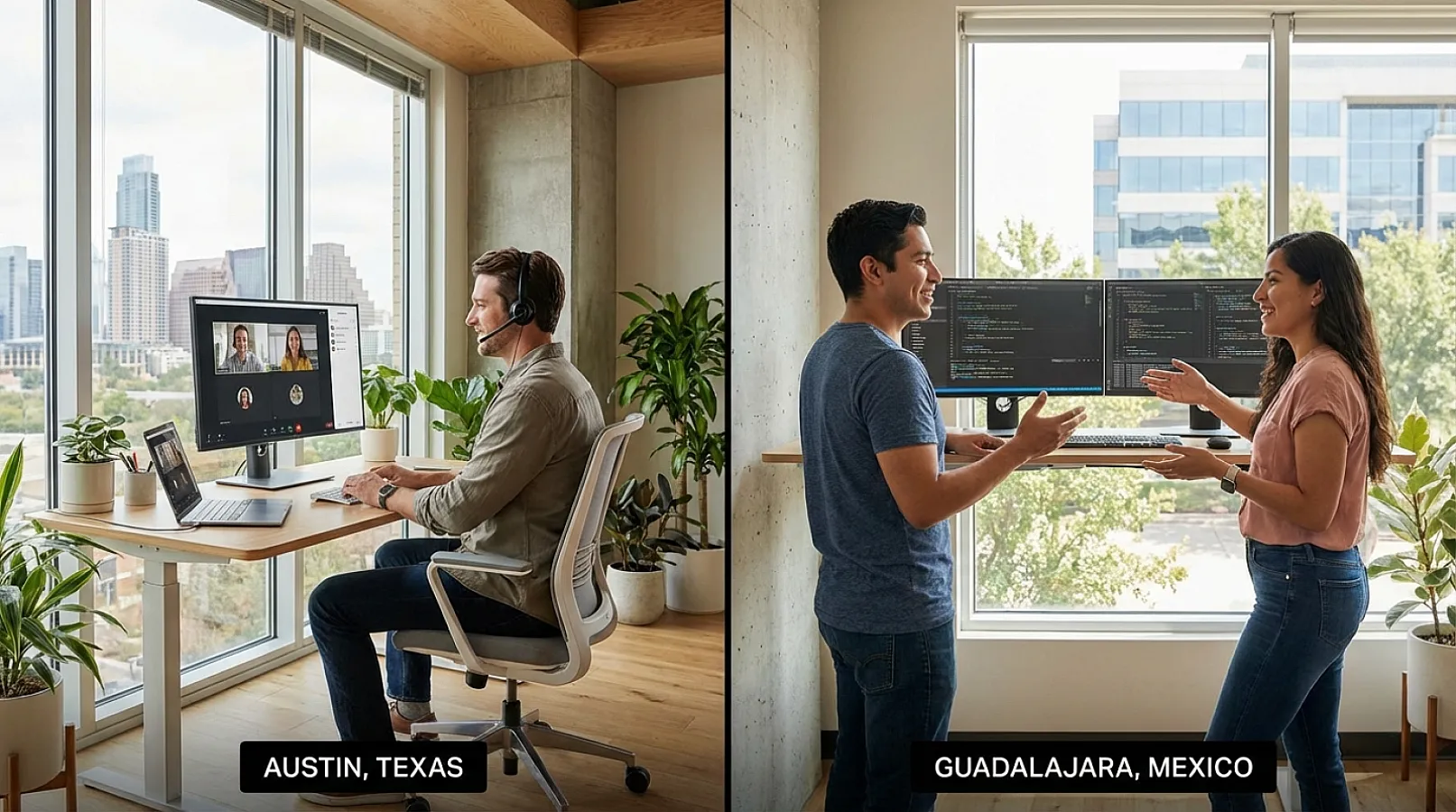
Cafali operates with leadership in Austin, Texas and engineering talent in Mexico. Same timezone. Same working hours. Same energy on the daily standup at 9 AM Central.
This isn't a marketing line. It changes how work gets done in ways that compound over weeks and months:
Real-time collaboration. When a developer hits a blocker at 2 PM, they get an answer at 2:15 PM. Not tomorrow morning. Not after a timezone-delayed Loom video. A live conversation that resolves the issue and keeps momentum.
Shared context. The team joins the same meetings, hears the same product discussions, and understands why a feature matters, not just what it should do. That context produces better code because developers make better micro-decisions when they understand the business goal.
Cultural alignment. Mexico's tech ecosystem has matured significantly. Cities like Guadalajara, Mexico City, and Monterrey produce engineers who grew up with the same tools, frameworks, and development culture as their US counterparts. The collaboration feels natural because it is.

The cost advantage is real but secondary. Mexican engineering talent costs 40-60% less than equivalent US talent. The primary advantage is that you get a team that operates like an extension of your company, not a vendor on a different continent.
The AI Skills Gap Nobody Talks About
Here's where most nearshore conversations miss the point. In 2026, the difference between development teams isn't just location or hourly rate. It's whether they've integrated AI into their actual workflow.
Most agencies, nearshore or otherwise, still write code the way they did in 2023. They might mention AI on their website, but their developers aren't using Claude Code for daily development, aren't running MCP servers for framework context, and aren't reviewing AI-generated pull requests with the rigor those PRs require.
At Cafali, AI-assisted development isn't a feature we sell. It's how we work:
Model selection based on data. We recently analyzed Laravel's Boost Benchmark results testing six AI models on real Laravel tasks. Based on that data, we use Sonnet 4.6 for routine development (94.3% accuracy, best value), Opus 4.6 for architecture decisions (95.6% accuracy on complex tasks), and we're evaluating GPT-5.3 Codex after it scored 99.4% on the same benchmark.
MCP context is mandatory. Laravel Boost improved every AI model tested in the benchmark. We run it on every project. A capable model with framework context outperforms a more powerful model flying blind.
Every AI-generated PR gets reviewed. We saw Haiku score 0/13 on one benchmark evaluation because it misconfigured a service provider. The app never booted. Code that looks correct and code that works are different things. Our review process treats AI-generated code with the same scrutiny as human-written code.

Continuous evaluation. We test new models, new tools, and new workflows as they ship. When Laravel published their benchmark data, we adjusted our stack within a week. The AI landscape moves monthly. Agencies that evaluated tools once in 2024 are already behind.
This matters for clients because an AI-native team ships faster without sacrificing quality. The productivity gain from AI-assisted development is real, but only when the team knows how to use it and when to override it.
How an Engagement Works
We structure engagements to eliminate the typical agency pain points: slow ramp-up, unclear ownership, and the constant feeling that you're managing your outsourced team more than your own product.
Week 1-2: Discovery and architecture review. Before writing any code, we review your existing codebase, understand your business model, and identify technical risks. This prevents the most expensive mistake in outsourced development: building on top of a broken foundation.
Week 3-4: Team integration. Your Cafali developers join your Slack, attend your standups, and start contributing to your codebase. No separate project management layer. No weekly status reports that summarize what you could have seen in real time.
Month 2+: Full velocity. The team operates as part of your engineering organization. Same tools, same processes, same accountability. The only difference is the billing structure.
We handle the complexity that makes international teams difficult: payroll, benefits, equipment, office space, and retention. You get dedicated engineers who feel like your team because, for all practical purposes, they are.
Who This Works For
Startups scaling their engineering team. You have product-market fit and need to go from 2 developers to 8 without the 6-month hiring cycle and $200K+ in US recruiting costs.
Companies needing AI-native developers. Your existing team writes good code but hasn't adopted AI-assisted workflows. Adding Cafali developers who already work with Claude Code, Boost, and MCP raises the entire team's capability.
Teams that tried offshore and got burned. You spent the money, got the code, but the product didn't ship on time or at the quality you expected. Nearshore with real-time collaboration solves the coordination problems that made offshore fail.
CTOs who need to move faster. You know what to build but your team is at capacity. Adding nearshore capacity lets you pursue the roadmap items that keep getting pushed to "next quarter."
What We Don't Do
Transparency matters more than a sales pitch:
- We don't do body shopping. You won't get a rotating cast of developers. Your team is your team.
- We don't bid on fixed-price projects with vague requirements. If the scope isn't clear enough to estimate, we'll tell you, and help you clarify it first.
- We don't pretend AI replaces engineering judgment. AI makes good developers faster. It doesn't make junior developers senior. Our team brings both the tools and the experience.
The Bottom Line
The nearshore advantage in 2026 isn't just about cost savings and timezone overlap. It's about finding a team that combines proximity with modern engineering practices. A team that uses AI to ship faster, reviews AI output with senior judgment, and integrates with your company like they're sitting in the next room.
That's what we built at Cafali. US leadership in Austin, engineering talent in Mexico, and an AI-native workflow that keeps improving as the tools evolve.
If you're scaling your engineering team and want nearshore done right, let's talk. 30-minute call. No pitch. Just an honest conversation about whether we're the right fit.